
Deputy Health Minister Dr. Grace Ayensu-Danquah: The Surgeon with a Herbalist's Heart
November 23, 2026 · by CEO Rafamall
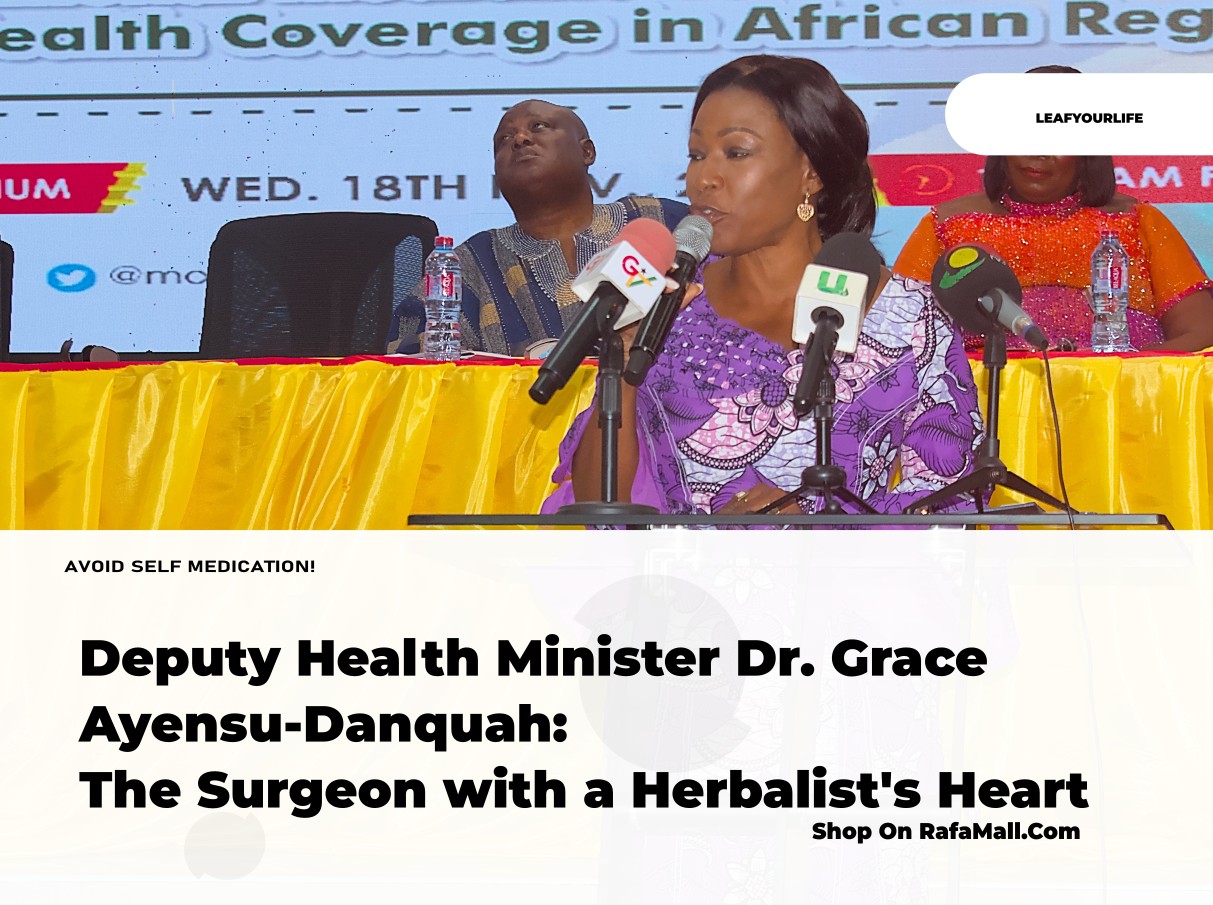
Dr. Grace Ayensu-Danquah, Ghana's Deputy Minister of Health, leads traditional medicine initiatives. Her approach is deeply influenced by her uncle, Professor Edward Ayensu, a pioneering botanist who authored "Medicinal Plants of West Africa" and contributed to malaria research. This family legacy informs her work in national health.
Professor Ayensu's work was not confined to cataloging. According to Dr. Ayensu-Danquah, he was instrumental in the establishment of botanical institutes in China and India—and, critically, in malaria research.
Why would a US-trained orthodox surgeon be placed in charge of traditional medicine in Ghana?
It is a fair question, and one that Dr. Grace Ayensu-Danquah, Deputy Minister of Health and Member of Parliament for Essikado-Ketan, has heard before. Her answer does not begin with policy. It begins with a man in a laboratory in Washington, D.C., surrounded by drying plants and long Latin names.
That man was her uncle, Professor Edward Ayensu—the pioneering Ghanaian botanist who wrote Medicinal Plants of West Africa in 1978, the first book of its kind for the region, and later Medicinal Plants of China and Medicinal Plants of the West Indies.
"He was my mentor and my best friend," Dr. Ayensu-Danquah says.
A Childhood Shaped by Botany
When she moved to America at seventeen, she lived in Washington, D.C., where her uncle worked as a botanist at the Smithsonian Institute. He was the first Black person to head a department there—a distinction that left an impression on the young woman who visited him from school.
"I used to go and visit him," she recalls. "All I could see was him looking at plants, cataloging plants, drying plants, taking photos of plants, and writing long names for plants."
She would sit in his lab all day, watching. He was, she says, "the only black man" in that space, and "it was only white people who came to talk to him." The contrast between his solitary, meticulous work and the attention it drew stayed with her.
"I was so impressed," she says. "So that started my journey in being very interested in traditional plants."
The Science Behind the Heritage
Professor Ayensu's work was not confined to cataloging. According to Dr. Ayensu-Danquah, he was instrumental in the establishment of botanical institutes in China and India—and, critically, in malaria research.
"When the Artesunate issue came up for malaria, he was very instrumental in coming up with a specific plant, and how you could extract the active ingredients to come up with a malaria treatment," she says.
That combination of traditional knowledge and rigorous extraction science shaped her own academic foundation. "My background is from traditional medicine, especially my academic background, because my uncle was the full-blown professor of traditional medicine, and medicinal plants, and a botanist," she explains. "So I know what plants can do."
The Books That Endure
Professor Ayensu's three books remain in circulation. Dr. Ayensu-Danquah notes with a smile that when she checked Amazon the day before, copies were listed at around $500 each.
"I have copies, original copies," she says. "But you can still buy them, because he has cataloged every single medicine that we are using."
A Personal Answer to a Public Question
The question of why a surgeon leads traditional medicine is one Dr. Ayensu-Danquah answers with her own biography. Her response is not a defense of policy, but a testament to a family legacy that began in a laboratory in Washington and now informs her work at the Ministry of Health.
"So when I was told that the ministry that was in charge of traditional medicine, I was very happy," she says. "Everybody was looking at me, but that is why."
For Dr. Ayensu-Danquah, traditional medicine is not a fringe interest or a political assignment. It is a heritage, a science, and a family inheritance—one she now brings to the national conversation on health.
Frequently asked questions
Who is Dr. Grace Ayensu-Danquah?
Dr. Grace Ayensu-Danquah is Ghana's Deputy Minister of Health and Member of Parliament for Essikado-Ketan, a US-trained surgeon with a strong background in traditional medicine.
What is her connection to traditional medicine?
She was mentored by her uncle, Professor Edward Ayensu, a pioneering Ghanaian botanist who wrote "Medicinal Plants of West Africa," which deeply influenced her interest in traditional plants.
Who was Professor Edward Ayensu?
He was a pioneering Ghanaian botanist, author of "Medicinal Plants of West Africa," and the first Black person to head a department at the Smithsonian Institute.
Why does Dr. Ayensu-Danquah lead traditional medicine in Ghana?
Her leadership stems from her family legacy and academic background in traditional medicine, inherited from her botanist uncle, Professor Edward Ayensu.
More from the journal
MoH Highlights Traditional Medicine's Role in Universal Health CoverageThe Ministry of Health has underscored the importance of traditional medicine in achieving Universal …Scientific research, regulation must guide traditional medicine practice - Dr Ayensu-Danquah
“Scientific research should not be seen as a rejection of our indigenous knowledge but …Health Ministry, WHO, and GHAFTRAM Converge in Accra for 27th Traditional Medicine Week Celebration
The Ministry of Health, in collaboration with the World Health Organization (WHO) and the …